





 Posts
Posts


In the last post I referred to the advances in biological sciences and some in engineering and computer science. Here are some more that will have a tremendous impact on your care now and into the future.
With the improvements in imaging devices such as MRI and CT scanners, it is now possible to do many procedures much less invasively in the radiology suite rather than in the OR as before. Uterine fibroids can be destroyed by passing a small catheter [about the size of a spaghetti noodle] into the arteries that feed the fibroid. Then small particles are inserted that block off that blood supply and the fibroid basically withers away. It is a rapid procedure with minimal recuperation time, especially compared to surgical removal of the uterus [hysterectomy.] Another example is resolving an aneurysm in the brain using similar catheters without the need for open neurosurgery.
Some tumors of the brain can be successfully treated with the “gamma knife” which is designed to give a huge dose of radiation to the tumor but not the rest of the brain. It is done in one procedure and the patient goes home the same or the next day. Other new radiation therapy procedures utilize very sophisticated equipment that can deliver the correct dose of radiation to the tumor, say in the prostate, but avoid most of the surrounding tissue such as the rectum and bladder. This makes the treatment more effective yet with fewer side effects.
Slowly but surely, all medical information is being digitized. As this happens it will be finally possible to have a total electronic medical record. This will mean your medical data is available anyplace, anytime. And it will mean that if you are sent to a specialist that your CT scan is available on line and you will not have to go to the radiology office to get it before visiting the specialist. This will save you time; the specialist can make an informed opinion immediately and will mean reduced costs. There are some important hurdles to overcome before this will be a reality but I am confident that they will be solved relatively soon.
With these and other advances medical care will be more custom tailored just for you; there will be a greater focus on prevention; it will be possible to repair, restore or replace a damaged organ; your medical data will be instantly available and medical care will be safer. Big advances.
Showing posts with label imaging. Show all posts
Showing posts with label imaging. Show all posts
Tuesday, September 1, 2009


Wednesday, August 19, 2009
Medical Megatrends –Expect These Advances in Medicine Soon
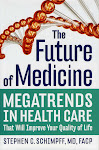
In the book “The Future of Medicine-Megatrends in Healthcare” I refer to several medical megatrends will profoundly affect medical care advances in the coming five to 15 years. Some are due to the explosion of basic understandings of cellular and molecular biology. Others are related to improvements in engineering and computer science. Together they will create huge shifts in medicine: First, medical care will become custom-tailored for the individual patient; second, prevention will come to the fore with the medical model moving from “Diagnose and Treat” to “Predict and Prevent”; third, repairing, restoring or replacing tissues and organs will be much improved; fourth, your medical information will be available, instantly, no matter where you are; and, fifth, medicine itself will become much safer and be of much higher quality.
Here are some of the advances in biological sciences. Genomics is at the heart of many. : Drug companies will be able to develop drugs that are designed from the beginning to be “targeted” to a specific problem – custom tailored. Already there are a number of new cancer drugs that fit this model such as Gleevec for chronic myelocytic leukemia. Today a physician must prescribe a drug knowing only that it works in “most” people but not whether it will work in you nor whether you will be among those to get a side effect. With genomic information, doctors will frequently be able to prescribe a drug for the individual knowing that first it will actually work and second that it will not have unexpected side effects. That will be a major advance. Genomics is already helping to subcategorize patients with the same type of cancer into those with good or poor prognoses – the former may need less aggressive treatment and the latter more aggressive approaches. Genomics also helps in early diagnosis. Imagine taking a sample of pus and knowing in less than an hour if it is infected with “staph” and whether it is resistant to antibiotics or not – a multiday process currently. And being able to predict what diseases a person might develop later in life [e.g. heart disease or colon cancer] would mean that a “prescription” for life style changes could be started to prevent or slow the disease occurrence [e.g., diet, exercise]. Or a drug might be prescribed early in life [e.g., statin to reduce cholesterol] or a procedure begun sooner than usual [colonoscopy for the person at high risk of early colon cancer.] All of these will mean more custom-tailored medicine for you and will change today’s medical paradigm from “Diagnose and Treat” to “Predict and Prevent.” And all of this will occur regardless of whatever healthcare reform emanates from Washington.
Other scientific advances are those of immunology which are making it possible to create new vaccines and improve our ability to transplant organs. There will be more vaccines to prevent many troublesome infections such as the new vaccines that prevent the “shingles” in older individuals and rotavirus diarrhea in infants. There are already vaccines that can prevent hepatoma, a type of liver cancer caused by one of the hepatitis viruses, and cervical cancer, usually caused by the human papilloma virus. And I will predict that there will be vaccines to prevent others cancers soon such as some types of leukemias and lymphomas and perhaps stomach cancer and some cancers of the head and neck. Look for vaccines to prevent or treat some of the most important chronic illnesses such as atherosclerosis and Alzheimer’s – these will be major advances. As to transplants, some day it will be possible to transplant an organ from a pig into a human without it being rejected. No longer will someone have to wait for another person to die to receive a heart, a lung, a kidney or liver.
Engineering and computer science is also advancing medicine rapidly. The new CT and MRI scanners give incredible images of our anatomy in a completely noninvasive manner. This means that diagnosis is much easier and more accurate and a surgeon knows exactly what he or she will find during surgery – a major advance.
Simulators - like those used by airline pilots for practice – will assist trainees before they ever approach a patient and will be used to test for competency and certification.
New technology in the OR will mean less invasive yet more effective surgery with a shorter recuperation time.
And there are many medical devices that have meant a restoration of normal function for many people. Think of the new heart pacemakers that regulate the heart’s rhythm or the defibrillators that prevent sudden death. Look for major advances here in the coming years. And similar devices can be used to reduce the frequency of epileptic seizures and even assist in treating depression.
In time, all medical information will be digitized and this will mean that there will finally be an electronic medical record – one that is available anytime, any place. This will mean much better health care for you, a big improvement for the doctor and a lower cost of care.
These are but some of the advances coming in the next few years. They will mean more custom-tailored medicine, better prevention, an increased ability to repair, restore or replace damaged organs, a medical record that is instantly available anytime or place and much safer medicine. It will be an exciting time to watch as medical care improves for all of us.
Here are some of the advances in biological sciences. Genomics is at the heart of many. : Drug companies will be able to develop drugs that are designed from the beginning to be “targeted” to a specific problem – custom tailored. Already there are a number of new cancer drugs that fit this model such as Gleevec for chronic myelocytic leukemia. Today a physician must prescribe a drug knowing only that it works in “most” people but not whether it will work in you nor whether you will be among those to get a side effect. With genomic information, doctors will frequently be able to prescribe a drug for the individual knowing that first it will actually work and second that it will not have unexpected side effects. That will be a major advance. Genomics is already helping to subcategorize patients with the same type of cancer into those with good or poor prognoses – the former may need less aggressive treatment and the latter more aggressive approaches. Genomics also helps in early diagnosis. Imagine taking a sample of pus and knowing in less than an hour if it is infected with “staph” and whether it is resistant to antibiotics or not – a multiday process currently. And being able to predict what diseases a person might develop later in life [e.g. heart disease or colon cancer] would mean that a “prescription” for life style changes could be started to prevent or slow the disease occurrence [e.g., diet, exercise]. Or a drug might be prescribed early in life [e.g., statin to reduce cholesterol] or a procedure begun sooner than usual [colonoscopy for the person at high risk of early colon cancer.] All of these will mean more custom-tailored medicine for you and will change today’s medical paradigm from “Diagnose and Treat” to “Predict and Prevent.” And all of this will occur regardless of whatever healthcare reform emanates from Washington.
Other scientific advances are those of immunology which are making it possible to create new vaccines and improve our ability to transplant organs. There will be more vaccines to prevent many troublesome infections such as the new vaccines that prevent the “shingles” in older individuals and rotavirus diarrhea in infants. There are already vaccines that can prevent hepatoma, a type of liver cancer caused by one of the hepatitis viruses, and cervical cancer, usually caused by the human papilloma virus. And I will predict that there will be vaccines to prevent others cancers soon such as some types of leukemias and lymphomas and perhaps stomach cancer and some cancers of the head and neck. Look for vaccines to prevent or treat some of the most important chronic illnesses such as atherosclerosis and Alzheimer’s – these will be major advances. As to transplants, some day it will be possible to transplant an organ from a pig into a human without it being rejected. No longer will someone have to wait for another person to die to receive a heart, a lung, a kidney or liver.
Engineering and computer science is also advancing medicine rapidly. The new CT and MRI scanners give incredible images of our anatomy in a completely noninvasive manner. This means that diagnosis is much easier and more accurate and a surgeon knows exactly what he or she will find during surgery – a major advance.
Simulators - like those used by airline pilots for practice – will assist trainees before they ever approach a patient and will be used to test for competency and certification.
New technology in the OR will mean less invasive yet more effective surgery with a shorter recuperation time.
And there are many medical devices that have meant a restoration of normal function for many people. Think of the new heart pacemakers that regulate the heart’s rhythm or the defibrillators that prevent sudden death. Look for major advances here in the coming years. And similar devices can be used to reduce the frequency of epileptic seizures and even assist in treating depression.
In time, all medical information will be digitized and this will mean that there will finally be an electronic medical record – one that is available anytime, any place. This will mean much better health care for you, a big improvement for the doctor and a lower cost of care.
These are but some of the advances coming in the next few years. They will mean more custom-tailored medicine, better prevention, an increased ability to repair, restore or replace damaged organs, a medical record that is instantly available anytime or place and much safer medicine. It will be an exciting time to watch as medical care improves for all of us.
Subscribe to:
Posts (Atom)