





 Posts
Posts


It was just 30 years ago in June 1981 when the first cases of what came to be known as Acquired Immune Deficiency Syndrome (AIDS) were published by the Centers for Disease Control (CDC) in its Morbidity and Mortality Weekly Report (MMWR.) These were men who had a wasting illness and died of unusual infections, ones of the types seen mostly in “immunocompromised hosts.” These were infections with which I was very familiar in my work treating and preventing infections in aggressively treated cancer patients at a branch of the National Cancer Institute. They included pneumocystis, cyrptococcus, toxoplasma, candidia, zoster, disseminated herpes simplex and others. They tended to develop in patients who had a type of cancer that suppressed their cellular immune function as in chronic lymphocytic leukemia, lymphoma, Hodgkin’s or after bone marrow transplantation. Some of these same infections occurred in patients who received drugs to prevent rejection after kidney, heart or lung transplants. So it was immediately clear that what would become known as AIDS was a disease that markedly affected the cellular immune function of these patients.
It would be only a few years, 1984, until the causative agent was discovered to be a retrovirus (Dr Robert Gallo and Dr Luc Montaginer) and a test was developed (Gallo) to render the blood supply safe. Meanwhile the initial years of what soon was recognized to be an epidemic were spent treating these opportunistic infections in these patients with a rapidly fatal disease once it was diagnosed as AIDS. In retrospect this was the first stage or phase of disease management; it would evolve over the years.
By 1987 the first of the antiviral drugs zidovudine (or AZT) to actually treat the underlying HIV infection was approved by the FDA after studies began at Burroughs Welcome by David Barry, MD and others and at the National Cancer Institute by Samuel Broder, MD and others. Approval came within 25 months of initial studies; a record at the time. Soon came many other drugs and by 1996 there were multiple active agents which when combined produced HAART or Highly Active Anti Retroviral Therapy. This was a distinct turning point because for the first time this lethal disease became a controllable chronic illness where one could survive for decades or possibly more. But if one stopped the drugs once immune function returned toward normal, the disease rapidly recurred in force. So it was suppressed but definitely not cured. Now the key was to get the drugs to the patient, get good compliance and give careful follow-up. Getting the drugs to the patient is no mean feat since they are inherently expensive and many patients are uninsured or underinsured. Taking multiple drugs many times per day is difficult for anyone but harder still if the person is living in poverty or is homeless or is a child with perhaps drug addicted parents. And careful follow-up is difficult for all of the same reasons plus others. And of course the challenges are perhaps even more difficult in many developing countries where the stigma of AIDS is high and the logistical means of getting both the drug and the caregiver to the patient are immense, yet this is just where the vast majority of infected individuals live.
Now a third stage has evolved. With many patients living very long times, caregivers are witnessing a set of new challenges. These are the consequences of long term chronic illness and long term drug treatment. Many patients develop a unique change in body habitus with loss of fat in the face and limbs but an increase in abdominal adipose tissue deep in and around the viscera. The metabolic syndrome is frequent and it is followed by diabetes in many. And late onset cancers of many types are being increasingly recognized. Early onset coronary artery disease is another manifestation of the changing nature of this disease and its treatment. Some believe that the chronic infection leads to chronic inflammation which in turn drives the intimal development of plaque in the coronary arteries and others like the carotids. Early onset osteoporosis is also common with 50 to 67% having osteoporosis or osteopenia well before the expected age. With continued loss of bone mineral density, the risk of fracture at an earlier age with its attendant implications for loss of mobility, hospitalization and death is high.
So for the physician, the change in these evolving stages has been from spending 90% time managing infections to 90% managing the complexities of therapy, its many complications and the long term complications of the chronic infection. Today, the HIV patient on HAART needs regular evaluations for coronary artery disease, metabolic syndrome and osteopenia with life style adjustments and possibly further drug interventions as preventive measures.
There are over 25 licensed antivirals for HIV infection and more are on the way. But whichever ones are used, they must be continued. Stopping has repeatedly proven to be linked to relapse and earlier death.
What will the forth stage be and when will it begin? Let us hope it is the discovery of a vaccine. Only a vaccine will ultimately drive the epidemic down and possibly even contain or eradicate it the way smallpox was or polio and measles could be. The HIV has proven to be very difficult to conquer with a vaccine. Some of the problems include that the initial infection usually goes unnoticed and then it remains latent for many years until the earliest evidence of AIDS appears. Another is the ubiquity of the virus and its ability to undergo sufficient change to escape immune detection. Once the T cell is infected, it is infected for life so a vaccine must be used before, not after, exposure. Of course, there has never been a vaccine produced before to a retrovirus so this in itself is a new hurdle with limited knowledge from former vaccine research to base today’s work upon. The vaccine must block the virus’ ability to enter the cell suggesting an antibody rather than a cellular immune-based vaccine. Dr Robert Gallo, Director of the Institute of Human Virology - believes the target must be the virus envelope – the “fingers” that attach to the T lymphocyte. He and his colleagues recently received over $24 million from the Gates Foundation and the military to further research in this direction.
With about 2,700,000 new infections per year worldwide, a vaccine cannot come too soon. But even when it does, the logistics of getting it to the world’s neediest will be fraught with difficulties. If getting susceptible children immunized against polio and measles has been difficult, HIV will be much more so.
Showing posts with label vaccines. Show all posts
Showing posts with label vaccines. Show all posts
Wednesday, June 29, 2011


Wednesday, August 19, 2009
Medical Megatrends –Expect These Advances in Medicine Soon
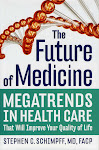
In the book “The Future of Medicine-Megatrends in Healthcare” I refer to several medical megatrends will profoundly affect medical care advances in the coming five to 15 years. Some are due to the explosion of basic understandings of cellular and molecular biology. Others are related to improvements in engineering and computer science. Together they will create huge shifts in medicine: First, medical care will become custom-tailored for the individual patient; second, prevention will come to the fore with the medical model moving from “Diagnose and Treat” to “Predict and Prevent”; third, repairing, restoring or replacing tissues and organs will be much improved; fourth, your medical information will be available, instantly, no matter where you are; and, fifth, medicine itself will become much safer and be of much higher quality.
Here are some of the advances in biological sciences. Genomics is at the heart of many. : Drug companies will be able to develop drugs that are designed from the beginning to be “targeted” to a specific problem – custom tailored. Already there are a number of new cancer drugs that fit this model such as Gleevec for chronic myelocytic leukemia. Today a physician must prescribe a drug knowing only that it works in “most” people but not whether it will work in you nor whether you will be among those to get a side effect. With genomic information, doctors will frequently be able to prescribe a drug for the individual knowing that first it will actually work and second that it will not have unexpected side effects. That will be a major advance. Genomics is already helping to subcategorize patients with the same type of cancer into those with good or poor prognoses – the former may need less aggressive treatment and the latter more aggressive approaches. Genomics also helps in early diagnosis. Imagine taking a sample of pus and knowing in less than an hour if it is infected with “staph” and whether it is resistant to antibiotics or not – a multiday process currently. And being able to predict what diseases a person might develop later in life [e.g. heart disease or colon cancer] would mean that a “prescription” for life style changes could be started to prevent or slow the disease occurrence [e.g., diet, exercise]. Or a drug might be prescribed early in life [e.g., statin to reduce cholesterol] or a procedure begun sooner than usual [colonoscopy for the person at high risk of early colon cancer.] All of these will mean more custom-tailored medicine for you and will change today’s medical paradigm from “Diagnose and Treat” to “Predict and Prevent.” And all of this will occur regardless of whatever healthcare reform emanates from Washington.
Other scientific advances are those of immunology which are making it possible to create new vaccines and improve our ability to transplant organs. There will be more vaccines to prevent many troublesome infections such as the new vaccines that prevent the “shingles” in older individuals and rotavirus diarrhea in infants. There are already vaccines that can prevent hepatoma, a type of liver cancer caused by one of the hepatitis viruses, and cervical cancer, usually caused by the human papilloma virus. And I will predict that there will be vaccines to prevent others cancers soon such as some types of leukemias and lymphomas and perhaps stomach cancer and some cancers of the head and neck. Look for vaccines to prevent or treat some of the most important chronic illnesses such as atherosclerosis and Alzheimer’s – these will be major advances. As to transplants, some day it will be possible to transplant an organ from a pig into a human without it being rejected. No longer will someone have to wait for another person to die to receive a heart, a lung, a kidney or liver.
Engineering and computer science is also advancing medicine rapidly. The new CT and MRI scanners give incredible images of our anatomy in a completely noninvasive manner. This means that diagnosis is much easier and more accurate and a surgeon knows exactly what he or she will find during surgery – a major advance.
Simulators - like those used by airline pilots for practice – will assist trainees before they ever approach a patient and will be used to test for competency and certification.
New technology in the OR will mean less invasive yet more effective surgery with a shorter recuperation time.
And there are many medical devices that have meant a restoration of normal function for many people. Think of the new heart pacemakers that regulate the heart’s rhythm or the defibrillators that prevent sudden death. Look for major advances here in the coming years. And similar devices can be used to reduce the frequency of epileptic seizures and even assist in treating depression.
In time, all medical information will be digitized and this will mean that there will finally be an electronic medical record – one that is available anytime, any place. This will mean much better health care for you, a big improvement for the doctor and a lower cost of care.
These are but some of the advances coming in the next few years. They will mean more custom-tailored medicine, better prevention, an increased ability to repair, restore or replace damaged organs, a medical record that is instantly available anytime or place and much safer medicine. It will be an exciting time to watch as medical care improves for all of us.
Here are some of the advances in biological sciences. Genomics is at the heart of many. : Drug companies will be able to develop drugs that are designed from the beginning to be “targeted” to a specific problem – custom tailored. Already there are a number of new cancer drugs that fit this model such as Gleevec for chronic myelocytic leukemia. Today a physician must prescribe a drug knowing only that it works in “most” people but not whether it will work in you nor whether you will be among those to get a side effect. With genomic information, doctors will frequently be able to prescribe a drug for the individual knowing that first it will actually work and second that it will not have unexpected side effects. That will be a major advance. Genomics is already helping to subcategorize patients with the same type of cancer into those with good or poor prognoses – the former may need less aggressive treatment and the latter more aggressive approaches. Genomics also helps in early diagnosis. Imagine taking a sample of pus and knowing in less than an hour if it is infected with “staph” and whether it is resistant to antibiotics or not – a multiday process currently. And being able to predict what diseases a person might develop later in life [e.g. heart disease or colon cancer] would mean that a “prescription” for life style changes could be started to prevent or slow the disease occurrence [e.g., diet, exercise]. Or a drug might be prescribed early in life [e.g., statin to reduce cholesterol] or a procedure begun sooner than usual [colonoscopy for the person at high risk of early colon cancer.] All of these will mean more custom-tailored medicine for you and will change today’s medical paradigm from “Diagnose and Treat” to “Predict and Prevent.” And all of this will occur regardless of whatever healthcare reform emanates from Washington.
Other scientific advances are those of immunology which are making it possible to create new vaccines and improve our ability to transplant organs. There will be more vaccines to prevent many troublesome infections such as the new vaccines that prevent the “shingles” in older individuals and rotavirus diarrhea in infants. There are already vaccines that can prevent hepatoma, a type of liver cancer caused by one of the hepatitis viruses, and cervical cancer, usually caused by the human papilloma virus. And I will predict that there will be vaccines to prevent others cancers soon such as some types of leukemias and lymphomas and perhaps stomach cancer and some cancers of the head and neck. Look for vaccines to prevent or treat some of the most important chronic illnesses such as atherosclerosis and Alzheimer’s – these will be major advances. As to transplants, some day it will be possible to transplant an organ from a pig into a human without it being rejected. No longer will someone have to wait for another person to die to receive a heart, a lung, a kidney or liver.
Engineering and computer science is also advancing medicine rapidly. The new CT and MRI scanners give incredible images of our anatomy in a completely noninvasive manner. This means that diagnosis is much easier and more accurate and a surgeon knows exactly what he or she will find during surgery – a major advance.
Simulators - like those used by airline pilots for practice – will assist trainees before they ever approach a patient and will be used to test for competency and certification.
New technology in the OR will mean less invasive yet more effective surgery with a shorter recuperation time.
And there are many medical devices that have meant a restoration of normal function for many people. Think of the new heart pacemakers that regulate the heart’s rhythm or the defibrillators that prevent sudden death. Look for major advances here in the coming years. And similar devices can be used to reduce the frequency of epileptic seizures and even assist in treating depression.
In time, all medical information will be digitized and this will mean that there will finally be an electronic medical record – one that is available anytime, any place. This will mean much better health care for you, a big improvement for the doctor and a lower cost of care.
These are but some of the advances coming in the next few years. They will mean more custom-tailored medicine, better prevention, an increased ability to repair, restore or replace damaged organs, a medical record that is instantly available anytime or place and much safer medicine. It will be an exciting time to watch as medical care improves for all of us.
Subscribe to:
Posts (Atom)